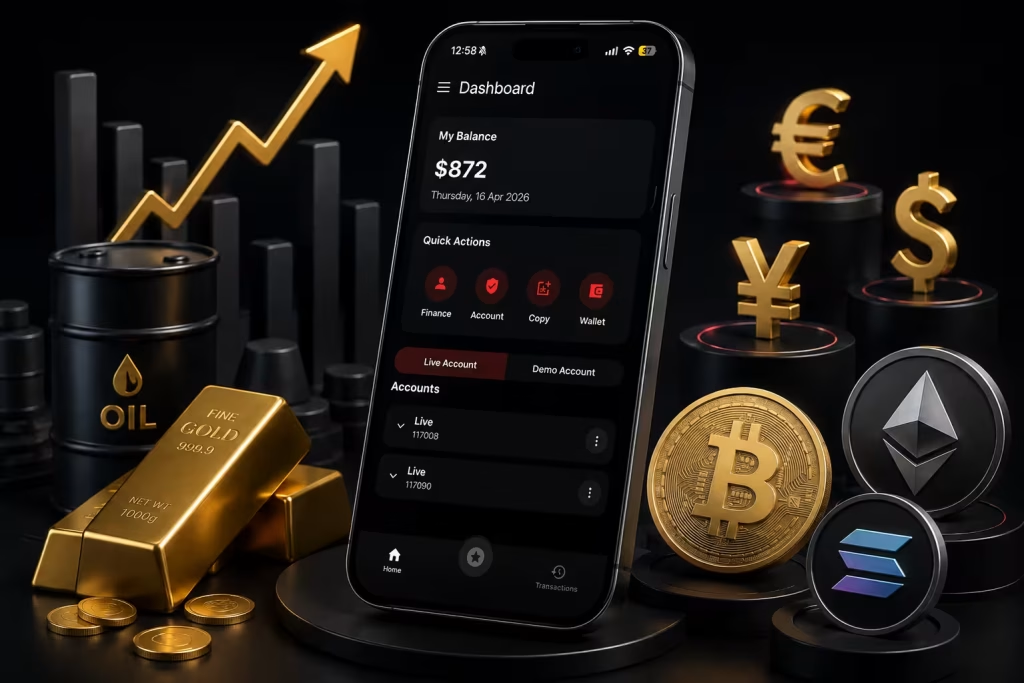
Introduction: Markets Don’t Fear Uncertainty — They Move Because of It
If there’s one word defining financial markets in 2026, it’s volatility.
From escalating geopolitical tensions in the Middle East to shifting central bank expectations, traders today are operating in one of the most dynamic environments in recent years.
But here’s the truth most traders overlook:
Markets don’t collapse because of uncertainty —
they reprice because of it.
At GFX Securities, we don’t just observe these shifts — we interpret them, structure them, and translate them into actionable insights for our clients.
Right now, several major forces are shaping global markets simultaneously. Understanding these forces is no longer optional — it’s essential.
1. Geopolitical Tension: The Core Driver of Market Votality
The ongoing conflict involving Iran, the United States, and Israel has become the primary catalyst behind global market behavior in 2026.
This isn’t just political noise — it’s a macroeconomic shock.
- Oil supply routes have been disrupted
- Shipping through the Strait of Hormuz has been restricted
- Energy markets have experienced extreme volatility
At one point, oil prices surged above $100 per barrel, marking one of the most aggressive moves in recent years .
This matters because energy is not just a commodity — it’s a global pricing mechanism.
When oil moves, everything moves.
2. Oil Markets: The Engine Behind Inflation and Volatility
Energy markets are currently the most sensitive asset class to geopolitical developments.
- The World Bank expects energy prices to rise by up to 24% in 2026 due to the conflict
- Supply disruptions have already reduced global oil flows significantly
- The Strait of Hormuz — responsible for ~20% of global oil transit — remains unstable
This creates a chain reaction:
Higher oil → Higher inflation → Central banks stay hawkish → Markets reprice risk
In fact, major institutions now expect no interest rate cuts in 2026, as inflation remains elevated due to energy shocks .
For traders, this changes everything.
3. Interest Rates: The Market’s Hidden Driver
Many traders focus on charts — professionals focus on liquidity conditions.
And right now, liquidity is tight.
- Central banks are delaying rate cuts
- Inflation remains above target
- Economic growth is slowing
This creates a rare environment known as:
Stagflation Pressure
- Rising costs
- Slowing growth
- Persistent uncertainty
This combination is extremely important because it reshapes asset behavior:
- Growth stocks struggle
- Commodities gain importance
- Safe-haven demand increases
4. Gold: Between Fear and Interest Rates
Gold has experienced extreme moves in 2026.
- It surged to record highs earlier in the year
- Then corrected sharply due to profit-taking and rate expectations
- Currently trading within a wide volatility range
Recent data shows gold pulling back as inflation concerns affect rate expectations .
But here’s the key insight:
Gold is no longer just a safe haven —
it’s a reflection of monetary policy expectations.
When rates stay high → gold struggles
When fear spikes → gold rallies
Understanding this dual behavior is critical.
5. Forex Markets: Where Everything Converges
The forex market is currently the clearest reflection of global uncertainty.
Currencies are reacting to:
- Interest rate expectations
- Risk sentiment
- Commodity flows
Recent trends show:
- The US dollar experiencing mixed momentum
- Safe-haven currencies like the Japanese yen gaining strength
- Commodity-linked currencies reacting to oil fluctuations
In volatile environments, forex becomes less about direction and more about:
Relative strength
It’s not “what goes up” —
it’s “what performs better than something else.”
6. Equity Markets: Resilient, But Selective
Despite global tensions, equity markets have shown surprising resilience.
- Gulf markets have recently risen on optimism around conflict resolution
- Corporate earnings remain strong
- AI-driven investments continue to support growth
However, this resilience is selective.
We are seeing a clear divide:
Winners:
- Energy companies
- Defense-related sectors
- AI & infrastructure
Under Pressure:
- High-growth tech (due to rates)
- Consumer-sensitive sectors
This is no longer a broad market rally —
it’s a targeted capital allocation environment.
7. Volatility: The New Normal
One of the most important realities traders must accept:
Volatility is no longer temporary — it’s structural.
- Oil shocks
- Political uncertainty
- Central bank shifts
- Supply chain disruptions
All of these are happening simultaneously.
Markets are no longer driven by a single narrative —
they are driven by overlapping macro forces.
8. What This Means for Traders (The GFX Perspective)
At GFX Securities, we simplify complex market environments into actionable principles.
Here’s how we approach current conditions:
1. Risk Management Is Not Optional
In volatile markets:
- Spreads widen
- Slippage increases
- Stop losses get triggered faster
This is not the time to over-leverage.
2. Opportunities Come From Dislocation
The best trades don’t happen during stability —
they happen during mispricing.
Volatility creates:
- Overreactions
- Panic selling
- Liquidity gaps
And that’s where professional traders operate.
3. Don’t Trade the News — Trade the Reaction
Markets move not on headlines, but on expectations vs reality.
A common mistake:
- Traders react emotionally to breaking news
- Professionals wait for confirmation and structure
4. Focus on Key Assets
Right now, the most relevant instruments are:
- Oil (energy driver)
- Gold (risk sentiment)
- USD (global liquidity)
- Major FX pairs (EUR/USD, GBP/USD)
These are not just assets —
they are market indicators.
5. Adapt, Don’t Predict
The biggest mistake traders make:
Trying to predict outcomes.
The market rewards those who:
- React
- Adjust
- Manage risk dynamically
9. The Psychological Edge: Staying Calm in Chaos
In times of geopolitical tension, psychology becomes a decisive factor.
Traders often experience:
- Fear of losing
- Overtrading
- Emotional decision-making
But the most successful traders:
- Accept uncertainty
- Stick to their system
- Focus on execution, not outcomes
Discipline becomes more valuable than strategy.
10. Where the Opportunities Are Heading
Looking forward, several themes will likely dominate:
1. Energy Markets
Continued volatility tied to geopolitical developments
2. Inflation Trends
Driven by supply shocks and commodity prices
3. AI & Infrastructure
Long-term growth theme supporting equities
4. Currency Divergence
Central bank policies creating FX opportunities
Conclusion: This Is Not a Crisis — It’s a Cycle
Markets in 2026 are not broken —
they are transitioning.
Every major shift in financial history has created:
- Fear for some
- Opportunity for others
The difference comes down to one thing:
Understanding the environment
At GFX Securities, our mission is simple:
To help traders move from reaction → to strategy.
Because in markets like these:
You don’t need to trade more.
You need to trade smarter.